Our Mission Statement

We seek tranquility
in the midst of conflict
or danger, and strive
to control our bodies,
minds and emotions,
to be able to avoid conflict
when possible, defend
ourselves when necessary
and protect others when able.

Karate Quote of the Day!

Published Literature

Mouse over the book cover to view a small exerpt from each acticle or book.  Some of the Articles are available in full, in PDF format, click the thumbnail of the article you want to access.

  • The Life and Times of Mitsusuke Harada

    Dr. Clive Layton. An absorbing martial arts biography of one of the few living masters to train with nearly all of the Japanese karate greats. Confirm some famous karate legends and shatter some myths at the same time! Discover which of the early masters were really good and why! Learn why Harada's Shotokai stands alone in distincive style


  • Reminisences

    Edited By, Dr. Clive Layton. As a sequal to Karate Master, more detailed martial arts history abounds! Harada's candid manner is a breath of fresh air in martial arts discussion. In the foreword by Jotaro Takagi, President of Japan Karate-Do Shotokai and Director of the Shotokan Dojo, it states: "As far as I am concerned, I consider Mr. Harada to be the highest karate leader in Europe..."


  • Voice of the Mountain Dragon

    Currently the ONLY text in print on actual KDS practice philosophy and training written by 5th Dan Bernard Mathieu, who lives and trains in France. Mr. Mathieu gives you an in-depth look at KDS principles and methods. With great photos and conversational style, basic fundamentals come alive. A must-read for all karateka, especially those interested in improving and progressing their personal practice."


  • MBE Interview

    Interview by Jonathan DeClaire.
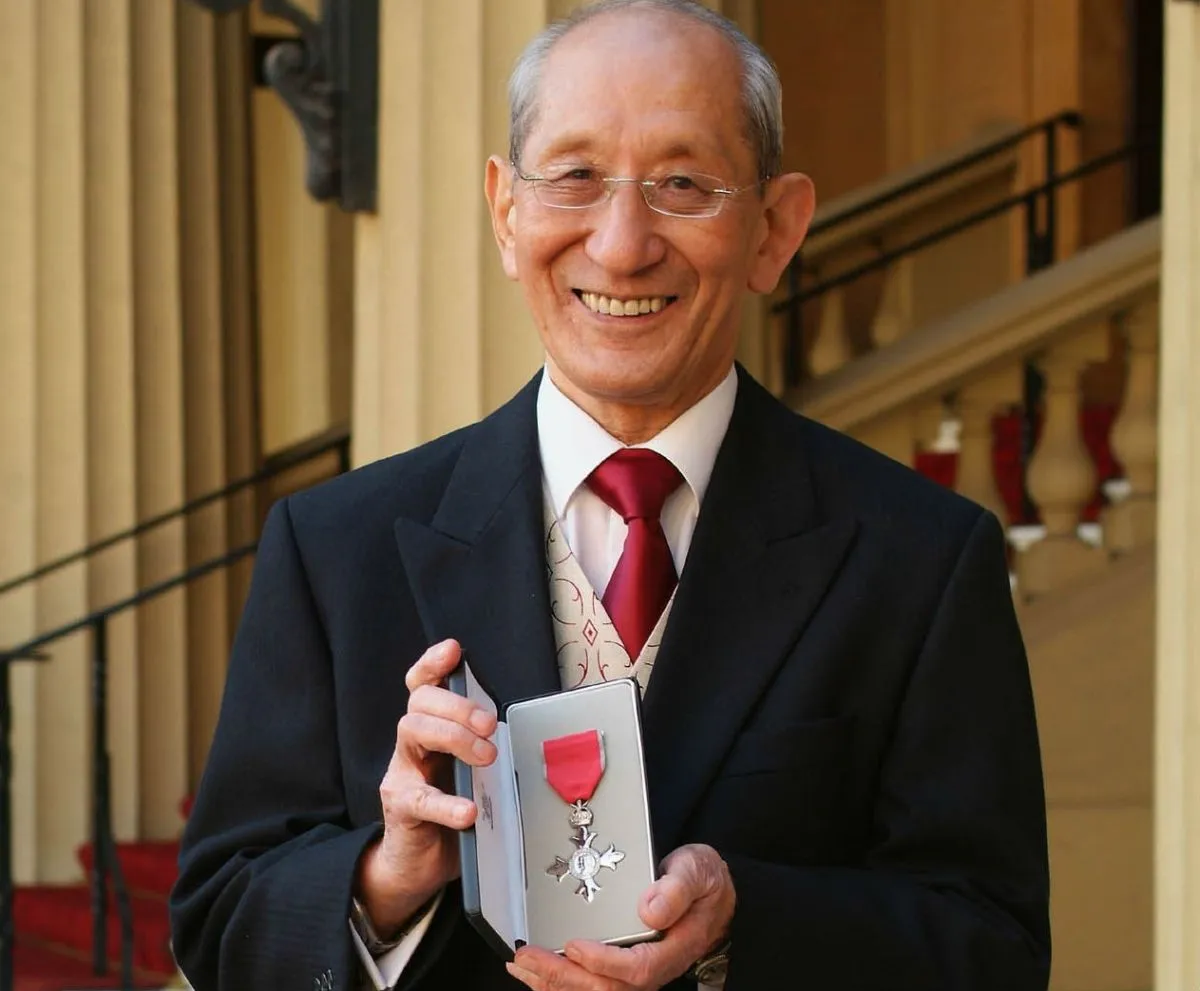
    JDC Harada Sensei, firstly, I wanted to congratulate you on being awarded the Member of the British Empire for Services to Karate.
    MH Thank you very much. This is a great honour for me, it was also total surprise! My people kept it a secret that this had been applied for and the first I knew of it was when I received a very official looking envelope. It was a complete shock!


  • Fighting Arts

    by Ken Waight. Magazine No. 90, pp. 35-38.
    "...The first time I saw Harada was at a big Martial Arts exhibition at the Royal Albert Hall... Kenshiro Abbe (the founder of the B.J.C.) had invited top-level teachers from all over Europe, to demonstrate their arts...and, representing karate, M. Harada. When this Master made his appearance, we had no idea what to expect..."


  • Traditional Karate

    by Jeff Bessent, Dec. 1991, p.36-41.
    "...TK: Sensei, could you give me some more information on the relaxed punch?
    Harada: It is an explosion of muscle energy transferred into your opponent.
    TK: Could you tell me more about the Mon (Logo) the K.D.S. use? Is it something to do with the Japanese Royal family?
    Harada: It is a funny story..."


  • Shotokan Karate Magazine

    by John Cheetham, pp. 24-26.
    "Q.: What are your views on Competition Kumite and also Competition Kata? A.: My personal view on competition is that I have nothing against it as every sport has competition. However, in Karate..." 


  • Shotokan Karate Magazine

    An interesting article appearing in Shotokan Karate Magazine's August 2000 issue by Jonathan DeClaire. Explains how KDS practice is actually 'ORTHODOX' Shotokan as it was once meant to be practiced..."


  • The Concept of Kiai


    Master Mitsusuke Harada presents his opinion on the concept of kiai and it's relevance and use within karate. Europeans tend to be rather keen on what they call rational explanations and complain that some Japanese concepts are obscure and not easy to understand. In that respect, one of the most frequently quoted is that of KIAI, and I am often asked to give my opinion on the matter.


MAGAZINE ARTICLES

Harada Sensei and KDS practice have been the topic of numerous magazine articles and interviews. We hope you enjoy the documents included below.

Concept of Kiai - Harada Sensei

MBE Interview...
Interview by Jonathan DeClaire. JDC Harada Sensei, firstly, I wanted to congratulate you on being awarded the Member of the British Empire for Services to Karate.
MH Thank you very much. This is a great honour for me, it was also total surprise! My people kept it a secret that this had been applied for and the first I knew of it was when I received a very official looking envelope. It was a complete shock! Read More?...


Fighting Arts...
by Ken Waight. Magazine No. 90, pp. 35-38. "...The first time I saw Harada was at a big Martial Arts exhibition at the Royal Albert Hall... Kenshiro Abbe (the founder of the B.J.C.) had invited top-level teachers from all over Europe, to demonstrate their arts...and, representing karate, M. Harada. When this Master made his appearance, we had no idea what to expect..."Read More?...


Traditional Karate...
by Jeff Bessent, Dec. 1991, p.36-41. "...TK: Sensei, could you give me some more information on the relaxed punch... Harada: It is an explosion of muscle energy transferred into your opponent... TK: Could you tell me more about the Mon (Logo) the K.D.S. use? Is it something to do with the Japanese Royal family? Harada: It is a funny story..." Read More?...


S.K.M....
by John Cheetham, pp. 24-26. "Q.: What are your views on Competition Kumite and also Competition Kata? A.: My personal view on competition is that I have nothing against it as every sport has competition. However, in Karate..." Read More?...


S.K.M....
An interesting article appearing in Shotokan Karate Magazine's August 2000 issue by Jonathan DeClaire. Explains how KDS practice is actually 'ORTHODOX' Shotokan as it was once meant to be practiced..."Read More?...


Karate Master: The Life and Times of Mitsusuke Harada, by Dr. Clive Layton, Bushido Publications, 1997, Preface ix-xi

"This book is about one rather special man's dedication to the art of karate-Do. Mitsusuke Harada has traveled the Way of the 'empty-hand' for more than fifty years now [as of 1997], having never wavered from his path, but single-mindedly pursued, and built upon, that which his teachers gave him. And what teachers they were! Beginning training at the famous Shotokan, he was taught by the powerful Motonobu Hironishi, the elegant Wado Uemura, and the disciplined Yoshiaki Hayashi. Harada knew the dynamic and spiritually-advanced Yoshitaka Funakoshi, who died young, yet whose influence is still so strong today. After the war, Harada had the enviable privilege of practicing, as a private student, under Gichin Funakoshi, the Okinawan master credited with introducing Karate-Do to Japan, and the inspiration for what became known as the Shotokan and Shotokai styles. At university he trained under the exceptionally-gifted, but eccentric, Master Tadao Okuyama, an inspiration, whose questions still haunt him, and was a private student of Master Shigeru Egami, during the master's most enquiring and intense period. He assisted Hiroshi Noguchi of Waseda University, whose training was so sever, in teaching Karate to undergraduates, and Masatoshi Nakayama, Chief Instructor to the Japan Karate Association, on an influential course to American Air force personnel. He was also a great friend and training partner to the legendary Tsutomu Ohshima, and practiced with such world-famous Karateka as Taiji Kase and Hidetaka Nishiyama in the late Forties and early Fifties. There can truly be few men alive today who can claim such an exceptional training background.

With the influence of such teachers and contemporaries running through his veins, Master Harada introduced Karate-Do to South America in 1955 with Gichin Funakoshi's personal blessing. He later taught briefly in France and Belgium before becoming the first Japanese karate teacher to reside in Great Britain in 1963. He has subsequently positively influenced two generations of enquiring students, and now heads the small and friendly Karate-Do Shotokai (KDS) association in Great Britain and the Karate-do Shotokai France, and travels widely throughout Europe, Scandinavia, and North Africa.

An intelligent and notably courteous man of quiet and reserved disposition, Master Harada has never sought the limelight, and consequently is not as widely known as he deserves to be. The author has heard many a famous Japanese and occidental master from varying martial arts speak of him with great respect. His style, in many ways so different from mainstream karate practice, and the way of thinking, are advanced and often difficult for the experienced, let alone inexperienced, to comprehend and appreciate. He is, if such a thing were desirable, a master's master--the epitome of what Karate-do can produce. To let his story go untold would be tantamount to a crime. Putting it plainly, without it the history of Karate-Do would be incomplete."

Reminiscences, by Master Mitsusuke Harada, by Dr. Clive Layton, KDS Publishing, 1999, Forward by Jotaro Takagi, President, Japan Karate-do Shotokai, Director of the Shotokan Head dojo, p. ix-x

"I first met Mr. Harada, personally, when he was a student in the University Karate Federation, on the occasion of a grading session and exchange of practice. At the time, in 1953/1954, we (Chuo University) requested Egami Shigeru Sensei to change our karate practice, which took place during special evening sessions. It may have been Mr. Egami who suggested that Harada and I should get together, for it was then that we had an opportunity to talk, which indeed marked the beginning of our acquaintance.

Again, in 1965, when I traveled to Brussels on business, Mr. Harada waited for me with several people, and subsequently invited me to practice at the dojo he was using. I must say that this episode constitutes one of the great memories of my life.

Mr. Harada began spreading karate in Brazil, then to several nations in Europe, and then, more recently, the USA. Thus a great part of his life has been spent living abroad, teaching and promoting Shotokan karate, for which I respect him greatly, and express my gratitude.

So, in those days, he practiced with Funakoshi Gichin Sensei, his son Yoshitaka Sensei, Mr. Hironishi Motonobu, and Mr. Egami Shigeru - all great seniors. he worked with dedication and developed his own Shotokan karate technique and ideas. This is why, as I am told, Mr. Harada is nowadays highly respected abroad as a karate leader. As far as I am concerned, I consider Mr. Harada to be the highest karate leader in Europe."

The Voice of the Mountain Dragon: Practicing with Harada Sensei, by Dr. Bernard Mathieu, KDS Publishing, 2003, Selections...

"PREFACE BY MASTER MITSUSUKE HARADA. This year marks the 80th anniversary of the time when O'Sensei Funakoshi Gichin introduced karate to the mainland of Japan from Okinawa. I remember that when I was a student I read a History of European Social Thought about which our professor had declared that if Saint Paul had not gone to Damascus the whole of European history would have been changed. Well, I now think that if Funakoshi Gichin had not come and introduced karate to Japan, not only would the history of karate itself have been different, but also the social history of the world.

Traditional Karate Magazine, Interview by ???, 19??, p.?

Mitsusuke harada was born in 1928. He started training in Karate at the age of 15 years when he joined the Shotokan Dojo of Master Gichin Funakoshi in November 1943. He received instruction from Yoshitaka Funakoshi, Motonobu Hironishi and other senior students in the dojo.

In March 1945 the Shotokan dojo was destroyed and Harada Sensei�s training was interrupted. In 1947 he began training under Master Funakoshi, entering Waseda University in 1948 where he joined the dojo under the guidance of Master Funakoshi and Hironishi Sensei.

After leaving Waseda University, Harada Sensei began training under Shigeru Egami until 1955 when he left Japan to work in a bank in Sao Paulo, Brazil. In 1956 he opened a dojo called the Brazil Shotokan Karate dojo, and also organized the Karate-do Shotokan Brazilairo as an organization to promote Traditional Shotokan Karate.

In 1963 Harada Sensei came to Britain to teach and demonstrate Karate at the invitation of Kenshiro Abbe the chairman of the British Judo Council. In the mid 60�s Harada Sensei founded the Karate-Do Shotokai--an organization dedicated to promoting his approach to Traditional Shotokan Karate-Do.

Harada Sensei was graded to 5th dan by Master Funakoshi. He had never claimed any higher grade, believing that anything beyond this is pointless. A man truly dedicated to the martial arts, Harada Sensei continued to teach his own students in Great Britain and others all over the world. As well as continuing to teach, Sensei Harada also continues to expand, his already greater awareness of other arts and in this interview talks about some of the arts he has experienced.

TRADITIONAL KARATE (TK): When you were posted to Brazil did you see any Capoeira or experience it?
HARADA SENSEI (HS): Oh yes. I saw some Capoeira, I do not know who the master was but some capoeristra came to my dojo. This was in 1956, some Japanese friends of mine told me about this art called Capoeira on the ship and they gave me some friendly warnings and said that some capoeirista might come to my dojo and challenge me because only judo was in Brazil at this time and they had accepted the challenge. Having not seen Capoeira before I was a bit surprised at first due to their fluidity of movement and that is why I decided to change the type of Karate I was doing at the time, the rigidness of Shotokan to a flowing movement. The movement was static but with Kime just like when hitting the Makiwara. The Capoeira was very smooth and flexible in its moves. This is how Karate should be done, but with the addition of speed.
TK: So the movements in Capoeira are similar to those practiced in Kawashi (Interaction) (Karate-Do Nyumon, Kodansha Publications)?
HS: Speed is of an essence which allows you to move in this way, just to do it.
TK: Sensei, did you also see any Gracie Ju-Jitsu when you were in Brazil?
HS: I heard about it, but I never saw it. I gather he was a very big man. I believe they were in Rio De Janeiro and I was in Sao Paulo.
TK: What are the precepts of the K.D.S. or the ideals?
HS: From the end of 1943 to the 10th of March 1945 I was training at the Shotokan in Tokyo, but I was just a school boy, how you say, junior. After the war all martial arts were suspended by General Headquarters. Most of the seniors had gone off to the war, so not so many people were training at this time, anyway I went to train under Hironishi Sensei who was a senior Shotokan Instructor at the dojo and quite occasionally Yoshitaka Sensei would teach. Once or twice he showed me something, personally. But anyway all the martial arts were stopped so I was very surprised to see Karate when I joined the University in 1948.
TK: Was this because Karate was not indigenous to Japan?
HS: No, I do not think that General Headquarters knew of karate at this time. However I feel that when I joined the university dojo the karate I did was different to theirs, the two dojos� karate was different.
TK: Could you please explain why they were different.
HS: At this time Karate was done for its own sake so there was no shiai (competition) the difference being in the way we stepped. At the Shotokan dojo we stepped like this and at the university dojo they stepped like this (Interviewers Note: Sensei demonstrated that at the Shotokan dojo they stepped with an in-out movement whereas the university dojo stepped with a linear movement). Something was different. Every Saturday Funakoshi Gichin Sensei would come down to the dojo to teach us but in his case he was too old to do this so he sat down and watched us do kata over and over again until he was happy with it, but there was no kumite (a meeting of hands). When our seniors took the class it was different--why? I found that a lot of the young seniors were influenced by Yoshitaka Sensei, this case I ponder, original Shotokan Karate and university karate were completely different.
T.K.: So the Shotokan karate as we know it today is Yoshitaka Sensei's?
H.S.: Yes in my case, I was very influenced by Yoshitaka Sensei's karate.
T.K.: Sensei on an historical note, when and who developed the mawashi-geri (round house kick)?
H.S.: A very good question, when I was looking in my books I could not find any mawashi-geri. We could not find it in O'Sensei's original book {Karate Do Kyohan, Kodansha publications) (Interviewers Note: At this point Sensei got out of his bag an original version of this book, written in Japanese. It had interestingly on the front the emblem of the Shotokan tiger. It was published in 1936 and translated by Oshima Sensei). There was no mawashi-geri in it but there was a Yoko-geri and a migazuke-geri (side kick and crescent kick respectively). Also a sokuto keage (blade swing kick). In my opinion the cross between the migazuki and mae-geri (front kick) is how it came to be. The migazuki-geri with its straight leg and the mae-geri with its snap in the knee is how I think it was developed by Yoshitaka Sensei and it came to called Mawashi-geri.
T.K.: When did it become common practice and what part of the foot was used for striking?
H.S.: It was done like this with Tsurmaski (pointed toe kick).
T.K.: Is it the same theory as the Ippon Ken (one knuckle punch)?
H.S.: Oh yes, this was by Yoshitaka Sensei who developed it. Hironishi Sensei used to walk like this, I say this because I saw it personally.
T.K.: Do the K.D.S. teach karate to children and if so what would you say to be the best age to start?
H.S.: Yes we do and the best age to start would be approximately seven, although it I depends on the child.
T.K.: And what is taught to them?
H.S.: It is games but karate orientated games and with the use of foam balls so as utilize the hip when they throw them, then some kata and lastly some more karate with the games aspect.
T.K.: Sensei in the Go-Ju Ryu demonstration we saw some body conditioning exercises, like the chishi (strength stone) did you do any of this when you started training and do you do any now?
H.S.: It is interesting that we have the same equipment as the Go-Ju Ryu but we wanted to do some body building (weight training) most of the seniors were against this as they believed it slowed you down. Personally I feel we needed some weight training with a good coach to develop some routines so as to not lose the speed. We have to be strong but not at the expense of speed.
T.K.: Did you do any stretching in those days as we know it.
H.S.: No, just warm ups, a type of aerobics or gymnastics. Just natural movements.
T.K.: Could you tell me more about Ki and its relation to the relaxed punch that you practice?
H.S.: I do believe that speed is more important than power. We need speed and how to create speed when breaking wood. We use 5lbs. of power because the wood has to be held strongly, but if the wood is held by one hand only, speed is important. Speed is of very great importance, that is my opinion.
T.K.: So Tameshiwara was practiced in the early days as was makiwara.
H.S.: Every one did makiwara, but if you do too much you can damage yourself. It can damage your hands and affect your work if you work in an office. If you are a professional instructor it is up to you how much practice you do.
T.K.: Sensei, on the aspect of kata especially the taikyoku set, shodan in particular, how much of your training time should be set aside for this group of kata?
H.S.: In my opinion it should be practiced at slow speed so as to get the correct form. It might even resemble tai chi practice and to concentrate all our focus on technique. Maybe in one training session 10-20 times it should be done. Sometimes fast sometimes slow.
T.K.: Do you practice all 6 of these kata (3 developed by Henri Plee)?
H.S.: The Shotokai were very surprised by the existence of 6 kata as there were only ever 3 taught at the Shotokan in Tokyo.
T.K.: As most schools only teach the first kata, could you describe all 3 kata's movements for us Sensei? H.S.: Taikyoku Shodan is Gedan Barai (low sweep block) with Chudan Oi- Tsuki middle punch). Taikyoku Nidan is Gedan Barai with Jodan Oi-Tsuki (head punch) and lastly Taikyoku Sandan is Chudan Ude Uke (middle block) Kokutsu Dachi with Chudan Tsuki to the side and Jodan Tsuki up the centre.
T.K.: Thank you for clarifying that point for us Sensei and on the subject of kata I visited the local K. D.S. club at the Community Centre near where I live and picked up a handout document. The contents of this were interesting. In the kata list at the back I saw four kata I was interested in learning more about. They were as follows: Matsukazi, Sanchin, Tensho and Hojo. Could you shed some light on these kata and their origin.
H.S.: Matsukazi was developed by Yoshitaka Sensei as a bow kata.
T.K.: I thought it was the old name for Wankan.
H.S.: No, definitely a bow kata.
T.K.: Sanchin and Tensho?
H.S.: Sanchin and Tensho are from Higaonna Sensei's Go-Ju Ryu but originally they were from Japanese Go-Ju Ryu. Now however we learn them from Okinawan Go-Ju ryu. Sanchin and Tensho are from Higaonna's Go-Ju ryu.
T.K.: And finally Hojo?
H.S.: This is a bokken kata unique to the K.D.S.
T.K.: Is this because you advocate a lot of bokken practice in the K.D.S.?
H.S.: Going back to the question on weight training, the seniors did not like us to do this so we used the heavy bokken to disguise it so as to allow us to develop physique.
T.K.: Could you tell us more about the seniors at the Shotokan and Waseda Dojo's.

Change and Development

Harada Sensei

Interview with Marie Kellett - April 2011

THE SHOTOKAN WAY